
 Views 6
 Admin
AdminBest Job Portal in India: Find the Right Jobs Online
If you've spent even a week job hunting in India, you know the drill. You check five different websites before breakfast, save a dozen job listings you'll probably forget about, and wonder why half the postings look like they haven't been touched since last year. It's a lot. That's basically why job portals exist in the first place someone decided all that scattered, tiring searching deserved one proper place to live.
Type best job portal in India into Google and you'll get page after page of results that all sound suspiciously alike. So rather than adding one more generic list to that pile, this guide actually digs into what a job portal does for you day to day, what tells a good one apart from a mediocre one, and how to use these sites so job hunting stops eating up all your free time.
What Is a Job Portal?
Think of a job portal as a matchmaking service, minus the awkward small talk. Basically, it's a website where companies post their openings and job seekers show up looking for them everything sits in one searchable place, so you're not hopping between fifty different company career pages.
Most portals boil down to a few basic things:
- Somewhere to search openings by role, industry, or city
- Filters so you can narrow things down by experience, salary, or job type
- A profile or resume upload that recruiters can actually see
- A direct "apply" button, instead of emailing HR and hoping for a reply
- Some way to track where your applications stand
That's the core idea behind any job website in India cut down the back-and-forth between job seekers and companies, and get both sides to a decision faster.
Why Bother Using a Job Portal at All?
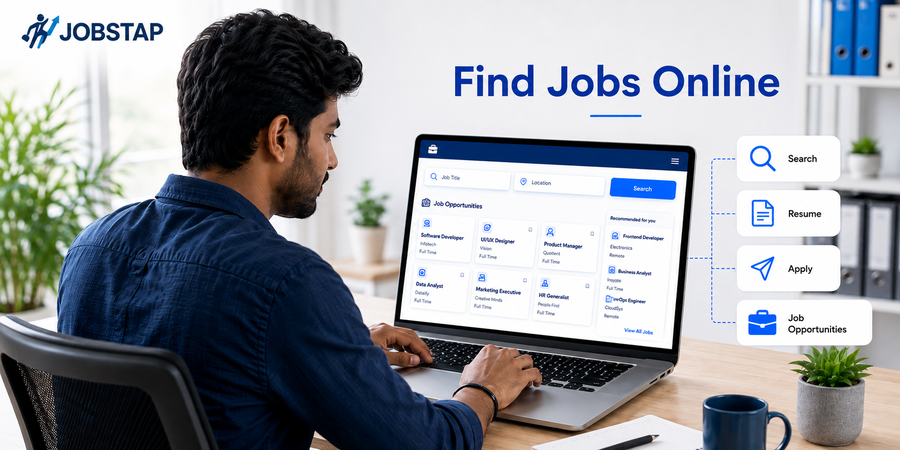
You could technically find a job without one through referrals, walk-ins, or word of mouth. People still do it. But India has thousands of companies hiring across hundreds of cities at any given moment, and there's no realistic way to track all of that on your own. Chances are, you'd never even hear about most of those openings.
A few reasons job search portals in India have become the default starting point:
- You're not tied to office hours. Search at 11 pm in your pajamas if that's when you have the energy for it.
- More doors open at once. One portal can surface job opportunities in India spanning IT, sales, logistics, hospitality fields you might not have thought to check.
- Categories actually make sense. Skilled, entry-level, freelance good portals sort this out so you're not wading through irrelevant postings.
- You can search by location, or skip it entirely. Stick to your city, or widen the net to remote work if that's on the table.
- Applying takes minutes, not hours. A saved resume and a couple of clicks beats filling out the same form for the tenth time this week.
- It works whether you're 22 or 42. Freshers and experienced professionals both use the same tools, just with different filters.
What Actually Makes a Job Portal Good?
Truth is, there's no single right answer here it depends on what you're looking for. A site that works brilliantly for a software engineer in Bengaluru could be completely useless for someone hunting warehouse work in a smaller town. Still, a few things are worth checking before you commit your time to any one platform.
| What to check | Why it matters |
| Variety of listings | A narrow portal limits your options before you've even started |
| Search and filters | Good filters save you from scrolling through irrelevant results |
| Relevance | Listings should match your field, not just pad out the numbers |
| How current the postings are | Nothing worse than applying to a job that was filled two months ago |
| Application process | The fewer unnecessary steps, the better |
| Overall usability | If the site is confusing, you'll give up before you find anything |
| Extra resources | Resume tips or interview guidance are a nice bonus, not a dealbreaker |
If a portal checks most of these boxes, it's probably worth your time whether it's a huge, well-known name or a smaller platform built for your specific field.
How to Pick the Right Site for Jobs in India
There's no single "right" site for jobs in India — the right one is whichever fits what you're actually looking for. A few practical questions to ask before you settle on a platform:
- Does it actually cover your field? Some sites lean hard into corporate and IT roles; others cast a wider net across skilled and unskilled work.
- Does it have real coverage in your city? A portal might be great nationally but thin in the specific location you're targeting.
- Is building a profile quick, or a chore? If updating your resume takes twenty minutes every time, you'll stop doing it.
- Do the listings look legitimate? Vague job titles, no company name, no clear description these are red flags, not just inconvenience.
- Is your data handled reasonably? A trustworthy platform is upfront about what happens to your information once you submit it.
Ten minutes spent checking these can save you weeks of applying into a black hole.
The Range of Jobs You'll Actually Find
One thing job portals do well is cover a lot of ground under one roof. Depending on the platform, you'll typically come across:
- Skilled roles that need specific training, certifications, or trade experience
- Unskilled jobs that don't require prior specialized background
- Entry-level and unskilled positions aimed at freshers or people early in their careers
- Part-time work for anyone juggling studies, family, or other commitments
- Full-time roles for standard, long-term employment
- Remote or online jobs you can do from home, or from anywhere really
- Positions for experienced professionals looking to move up or switch fields
That mix is really the point the same portal that helps a college graduate land their first job can also help someone with fifteen years of experience find their next move.
A Practical Way to Search for Jobs Online
If you're new to this, here's a process that actually works, rather than just clicking "apply" on everything that shows up:
- Get specific about the role you want. "Graphic designer" gets you far better results than "something creative."
- Decide on a location. Local, a specific city, or open to remote know this before you start searching.
- Search and filter. Use the portal's tools to narrow things down instead of scrolling endlessly.
- Actually read the requirements. Not just the title the qualifications, the responsibilities, the fine print.
- Get your resume in shape. Tailor it toward the kind of roles you're going after, not a one-size-fits-all version. If you need a starting point, this guide on how to write a resume walks through the basics.
- Apply where you're a genuine fit. Quality over quantity, every time.
- Keep track of what you've applied to. A simple spreadsheet works fine you'll thank yourself later.
Do this consistently and you'll usually see better results than firing off applications at random.
Why Jobstap Can Help With Your Job Search
Jobstap is built around a simple idea: make it easier for job seekers in India to find roles that actually fit them, instead of drowning them in postings that don't. The platform organizes listings across categories, so whether you're a fresher, a skilled tradesperson, or someone with years of experience, you're not stuck wading through everything else to find what's relevant.
If you're currently in the middle of a job search, it's worth taking a few minutes to browse what's live on Jobstap.in right now and see what fits your field and location.
Getting More Out of Job Portals
Using a job portal well isn't just about applying to as many listings as possible that approach tends to backfire. A few habits that actually move the needle:
- Keep your resume current. An old phone number or a missing recent job can quietly cost you an interview.
- Use the job titles and skills recruiters actually search for. It helps your profile surface in the right places.
- Stick to roles you're genuinely qualified for. Applying wildly outside your skill set wastes everyone's time, including yours.
- Read the job description properly. Not skim it actually read it, so there are no surprises later.
- Resist the urge to apply to everything. A handful of well-targeted applications usually beats fifty scattershot ones.
- Track what you've sent out. You don't want to be caught off guard by a call you weren't expecting, or forget to follow up.
- Trust your instincts with sketchy offers. If a "job" wants money upfront or sounds too good to be true, it probably is verify before you engage.
Frequently Asked Questions
1. What is the best job portal in India?
Honestly, that's not really a fair question the "best" one depends entirely on your field and where you're based. A better way to think about it: does the platform have listings that fit you, filters you'll actually use, and an apply button that doesn't send you down a ten-minute form?
2. How do I find jobs online in India?
Sign up on a portal, get your resume sorted, and fill out your profile properly half-done profiles don't get noticed. Then use the search filters to zero in on your role and city, and apply where things genuinely line up with what you can bring to the table.
3. What should I look for in a job portal?
Fresh listings, not month-old ones sitting there for the sake of it. Filters that actually narrow things down instead of just being decorative. And ideally, an application process that doesn't ask you to redo everything you just typed. Resume or interview tips are a nice touch if they're there.
4. Can freshers find jobs through online job portals?
For sure freshers are actually one of the biggest groups using these platforms. Search for "entry-level" or "internship" specifically, and you'll skip past a lot of roles that need three years of experience you don't have yet.
5. How can I apply for jobs online?
Set up your profile, attach a resume that's actually current, and click apply on whatever fits. Every now and then a listing bounces you over to the company's own careers page instead — either way, it rarely takes more than a couple of minutes per job.
6. Are job portals useful for experienced professionals?
Very much so, actually. Seniority filters cut out all the fresher-level noise and put mid-to-senior roles right in front of you, which honestly makes the whole process faster once you've got a few years behind you.
7. Are job portals free to use?
Mostly, yes. Building a profile, uploading your resume, and applying to jobs is typically free across most platforms. A few sites tuck in optional paid add-ons, so a quick scan of the terms doesn't hurt.
8. How many job portals should I use at once?
No fixed rule, but chasing ten platforms at once usually just means doing everything half-heartedly. Two or three that genuinely suit your field will serve you better than spreading yourself thin.
9. Can I find local or city-specific jobs on job portals?
Yes city and region filters are pretty standard on most portals, so whether you're staying put or open to relocating, narrowing the search down isn't hard.
10. How often should I update my job portal profile?
Every few weeks works well if you're actively searching. Doesn't need to be a big overhaul a new skill added, a small edit, a corrected number just enough to keep your profile from going stale in the eyes of recruiters.
Ready to Start Looking?
Finding the right job in India gets a lot less painful once you're using the right tools. A solid job portal saves you time, puts more relevant opportunities in front of you, and takes some of the friction out of applying.
Whenever you're ready, head over to Jobstap.in and see what's currently open in your field.